A few days ago 6 positions were posted for you to try and solve here.
Now, if you’ve had time to try and solve these for yourself, please check your answers/analysis here and let us all know how many you got right by posting in the comments.
Chess, like the arts, had a “Romantic” period (19th Century). An era characterised by open, tactical games, with brash sacrifices.
Winning was good, winning in style was better. Fashionable openings of the day included the King’s Gambit and the Evans Gambit.
A time when declining a sacrifice was considered at best unsporting, and at worst, out right rude.
Some of the games played in this era have become famous, usually for a beautiful combination and the games even have their own names!
Two eminent players of the era were Anderssen and Kieseritzky, who played a game that would become forever known as the “immortal” game.
Take a nostalgic minute to play over the game here, whilst trying to imagine what masterpieces you could have created had you lived in this era.
NB: The game is presented without annotations. The analysis could basically point out how almost every move is incorrect. However, the beauty of this game lies not in its technical accuracy but in its representation of a time, a wonderful time, gone by.
Tonight saw round one of the Club Championship A & B leagues with the following results:
A-League
George Hollands 1 Vs 0 Robert Thompson
Jerry Pol 0 Vs 1 Bob Fenn
B-League
Neil Miners 1 Vs 0 Richard Mallery
Hugh Broadbent 1/2 Vs 1/2 William Patch
Below are six positions for you to try and solve. As the norm I’ll be following this format: The first position will be fairly easy. Positions 2-5 will be a mixed bag but will contain at least one endgame position (not a study). The last position will require some fiendish calculation to solve.
Word of warning. These aren’t all play and mate tactics. Some positions may simply require a simple win of a pawn or an exchange.
The best way to attempt these is to write the lines you see down (or if you’re brave, post them in the comments) so that when the solutions are revealed in a few days, you don’t cheat yourself by pretending you saw a line that you didn’t. Continue reading
Steve Giddins has a weekly column over at TheProblemist.org which is well worth a look. Each week sees a new problem posted for readers to try and solve, with the solution following a few days later.
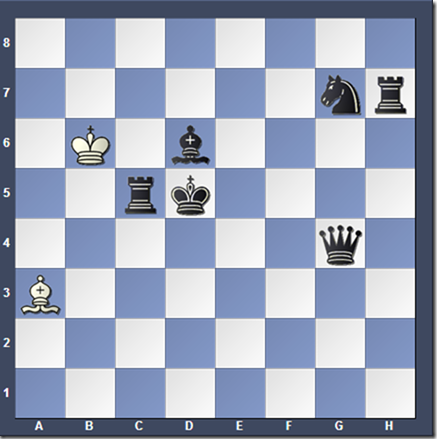
The position below is this week’s problem, a helpmate with 2 solutions. (Usually in a helpmate, Black moves first but in this one it is White.) Both solutions are 6.5 moves long, with White moving first and mating Black on his 7th move.
For the solution and for further details please check out the full column here.
No fantasy, however rich, no technique, however masterly, no penetration into the psychology of the opponent, however deep, can make a chess game a work of art, if these qualities do not lead to the main goal – the search for truth. – Vasily Smyslov
Recently, upon launching the new site, we thought it would be a good idea for the match captain to nominate a game after each match for annotation/publication to appear on the website.
After the recent Harvey Cup match against Medway, Neil’s instructive win over Isaac Oluwole was selected. The game can be replayed here.
In our first game I take a look at Rossolimo Vs Romanenko. An 18 move miniature in the “Rossolimo Sicilian” from 1948.
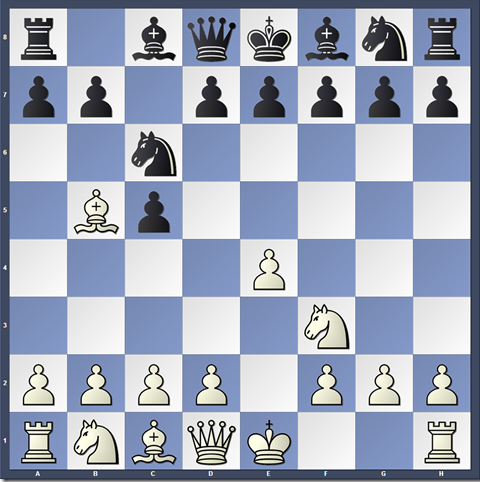
The opening is currently a very fashionable way to play for White, with a number of games in the Anand Vs Gelfand World Championship and the recent Candidates tournament springing to mind.
The game, with my annotations can be replayed here.

